🚨Closing Playbook is Live at 3:30 p.m. ET🚨
I’m out traveling today so Nate will captain the ship for Closing Playbook — be sure to drop by and see what he’s cooking up [tap to join us for Closing Playbook]!
There’s something I need to get straight about trade rescue strategies. I know it’s tempting when a position moves against you to try to fix it, modify it or rescue it somehow.
But here’s the reality…
Every time you attempt to repair a losing trade, you’re systematically destroying your reward-risk ratio.
Taking a loss feels like failure, which is why traders instinctively look for a way out. But repairing a trade requires you to know exactly what you’re doing. You must understand the dynamics of the original position, recognize what it has become, and identify an adjustment that fits the current market.
That’s far more difficult than simply moving a strike.
Let me show you exactly what I mean with a real example I recently walked through.
I had an iron condor with strikes at 7,625 and 7,630 that brought in a $0.90 credit. That gave me a 1-to-4 reward-risk ratio — a maximum profit of $90 against a maximum loss of $410.
Not perfect, but workable.
Then the market moved against me to 7,710. The natural instinct? Close the calls, sell new ones farther out at 7,800 and give the position room to recover.
But any modification from this point forward guarantees a loss. Even if I adjust the position to create a theoretical breakeven point, that breakeven is below where the market currently trades.
I would need the market to move in my favor with no cushion for error.
The Math That Kills Rescue Trades
After attempting the repair, my maximum profit shrinks from $90 to just $20 while my maximum loss increases from $410 to $480.
Think about that. I just threw another $70 at this trade for the chance to make $20.
That’s not a repair — that’s digging the hole deeper.
The fundamental problem with repairing trades is that the reward-risk ratio becomes extremely unfavorable. The ratio that started at 1-to-4 can deteriorate to 1-to-10, 1-to-12 or even 1-to-20, depending on how far the market has moved. Each additional adjustment risks more capital for an increasingly tiny potential profit.
This is the same dynamic you see in martingale strategies — each time you double down, the ratio goes from 1-to-1 to 1-to-3, then 1-to-7 and then 1-to-15. It compounds exponentially against you.
The Superior Alternative
Here’s what I do instead. Take that same $70 I would’ve used for the repair and build a fresh bear put spread at 7,685.
That new position gives me a maximum loss of $180 and a maximum profit of $320 — nearly a 2-to-1 reward-risk ratio. That’s dramatically better than committing more capital to the old trade for a tiny possible return.
Forget about the old trade. Take the loss. Then focus on making a really good next trade instead of trying to fix your old bad one.
Kane Shieh
Kane Shieh Trading
Follow along and join the conversation for real-time analysis, trade ideas, market insights and more!
Important Note: No one from The TradingPub team or Kane Shieh Trading will ever contact you directly on Telegram.
*This is for informational and educational purposes only. There is inherent risk in trading, so trade at your own risk.
There’s a brand-new secret that helps us spot stocks that Wall Street’s buying at that very moment…
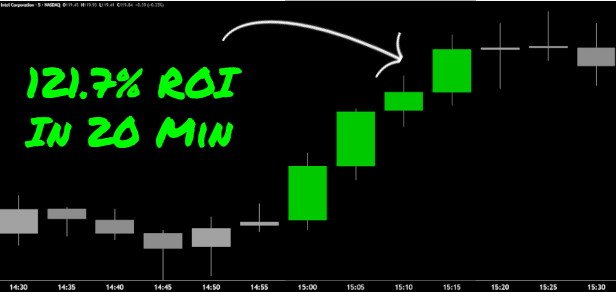
Giving us shots at double- and even triple-digit returns in minutes!