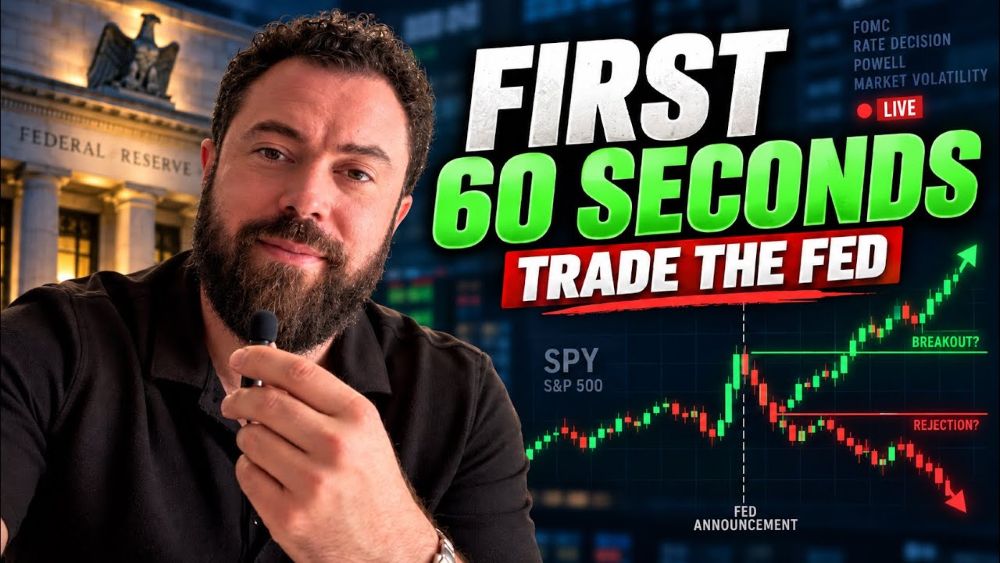
🚨I’ll be live at 3:30 p.m. ET with Nate🚨
It’s Build a Fed Trade Day and more [tap to join us for Closing Playbook]!
There’s a mathematical reality about spread trading that many traders never fully grasp — and it explains why so many spin their wheels without making real progress.
Market makers price trades to produce zero expected value based on their probability models. Not negative, not positive — exactly zero.
Here is the math behind what you’re up against…
The Zero Expected Value Trap
Suppose you’re considering an 80-delta spread on the S&P 500 ETF (SPY) expiring tomorrow. The market maker offers 20 cents of credit against 80 cents of risk. That’s a 25% return if the trade succeeds.
If you accept the market maker’s 80% probability of success, the expected value is zero: (0.80 × 25%) + (0.20 × −100%) = 0%. You have an 80% chance of making 25%, and a 20% chance of losing 100%.
So the outcomes cancel each other out.
This isn’t an accident. Market makers are efficient, especially in highly liquid products such as SPY, and generally offer prices that leave traders with no modeled edge.
So why do some trading programs achieve profit factors above 1 and produce gains across more than 100 trades? Because they evaluate the market differently from the market maker.
Creating an Edge by Rejecting the Price
The key is identifying specific moments when the market maker may be wrong — then taking trades only when the price reflects that discrepancy.
Instead of accepting 20 cents, suppose you require 25 cents. On a $1-wide spread, that means risking 75 cents to make 25 cents — a potential return of roughly 33%. If your estimated probability of success remains 80%, the expected value becomes positive.
This is why successful programs establish minimum-credit requirements. They seek moments when market pricing temporarily becomes misaligned with their probability estimates.
Market makers adjust their estimates minute by minute. Your model might hold the probability of success at 80% while the market maker temporarily reprices it at 75%, only to return to 80% a half-hour later. That short-lived disagreement may create the entry price you want.
Execution also matters. If a 763/764 spread will not fill at your required credit, shifting to 762/763 may produce a fill because the new strikes carry different pricing.
But changing strikes also changes the trade’s probability and risk profile, so the adjusted position must still satisfy your rules.
That’s the potential edge. You’re not simply accepting the market maker’s assumptions — you’re using a different framework, waiting for favorable pricing and adjusting the entry without abandoning your criteria.
The math is clear…
Accepting standard pricing based on the market maker’s probabilities offers zero expected value at best. Insisting on a better price creates a discrepancy between the market maker’s model and yours. If a sufficiently large track record shows your model is more accurate in those moments, that difference is where profits can emerge.
Kane Shieh
Kane Shieh Trading
Follow along and join the conversation for real-time analysis, trade ideas, market insights and more!
Important Note: No one from The TradingPub team or Kane Shieh Trading will ever contact you directly on Telegram.
*This is for informational and educational purposes only. There is inherent risk in trading, so trade at your own risk.
I teamed up with Roger Scott to reveal the market phenomenon tipping off One Hour Jackpots.
As you’ll see, these are some of the most lucrative one-hour payout opportunities on record!