
>>>Be sure to join me and Nate Tucci weekdays at 3:30 PM ET for Closing Playbook — we’ll do some live trading, teach you our methods, cover what’s moving markets and more, CLICK HERE TO JOIN US!<<<
There’s a trading catastrophe I need to tell you about because it perfectly illustrates why certain strategies — no matter how conservative they seem at first — are designed to blow up your account.
A guy named David Chow, who calls himself Captain Condor, had a group of around 1,000 investors trading iron condors on the S&P 500 (SPX).
Collectively, they lost $50 million.
Not because iron condors are inherently terrible but because they combined them with something far more dangerous: a martingale betting system.
If you’re not familiar with that system, here’s the basic idea. You start small — say with a $1 bet. If you lose, you double to $2. Lose again, double to $4. Then $8, then $16.
It feels manageable in the beginning because the numbers start small, and there’s this illusion that you’re always one win away from getting back to even. But that illusion is exactly how the trap is set.
Why Martingale Systems Destroy Your Reward-Risk Ratio
The danger isn’t just in doubling the size of each trade. It’s in how quickly the math turns against you once losses begin to stack. After seven consecutive losses, you’re already down $7 total, and your next bet requires risking $8 just to make one.
That’s an eight-to-one risk-reward ratio working against you — and it only gets worse from there.
By the twelfth loss, the total amount you’ve put at risk exceeds $2,000, all in pursuit of recovering a single dollar. It doesn’t matter how conservative you start. The exponential growth in position size guarantees that sooner or later, the system pushes you to place an absurdly oversized bet.
People get fooled because martingale systems often work for a long time. You can string together dozens or even hundreds of successful cycles without a blowup. Winning streaks produce confidence, confidence leads to larger allocations and the entire operation starts to feel safe and predictable.
But the law of large numbers doesn’t care how often the system worked for you in the past. It ensures that given enough time, the improbable losing streak you never planned for is guaranteed to show up — and when it does, the system forces you into ruin.
This Is Exactly What Happened to Captain Condor’s Group
They had a wipeout where they doubled down and that last allocation was the entire remaining balance of their accounts. When they lost it, people lost hundreds of thousands of dollars individually.
The strategy didn’t fail suddenly — it failed predictably. It was only a matter of time.
Iron condors already suffer from poor reward-risk ratios, typically risking $1,000 to make $100 or $200. When you pair that with a system that forces you to keep increasing trade size after every loss, you’re engineering a scenario where a catastrophic failure isn’t a possibility — it’s the mathematical endpoint.
The lesson is simple: Any strategy that requires increasing risk after a loss is destined to fail. You can fool yourself for a long time, stacking wins and enjoying smooth months or even years.
But the math never stops looming. Eventually, the streak hits, the doubling catches up and the entire account evaporates.
Kane Shieh
Kane Shieh Trading
Follow along and join the conversation for real-time analysis, trade ideas, market insights and more!
Important Note: No one from The TradingPub team or Kane Shieh Trading will ever contact you directly on Telegram.
*This is for informational and educational purposes only. There is inherent risk in trading, so trade at your own risk.
P.S. Wall Street’s Already on The Move This New Year!
I’ve revealed a breakthrough that tracks ALL of Wall Street’s largest options positions in real time…
And gives actionable options trade alerts before the stock has a chance to move!
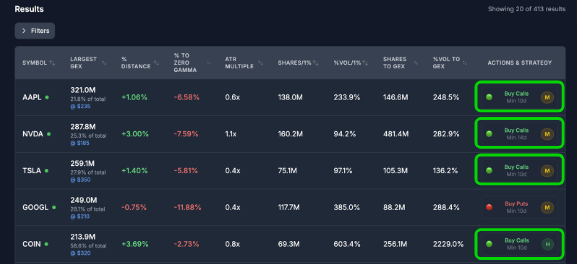
The best part is you’ll see how you can access our TOP trades to take today.
Sound good to you?